
Two pieces crossed my feed this week that land in the same place.
The first: Damien Riehl's interview on Legally Disrupted. Damien is a litigator turned legal technologist at Clio. He describes in-house counsel typing questions into AI tools and getting answers in twenty seconds (cases, statutes, regulations across jurisdictions) that used to require an email to outside counsel, associate hours, and a five-figure bill.
The second: a thread on X by @zackbshapiro. The replies get heated (see @SMB_Attorney).
Both pieces land in the same place: if in-house counsel and sophisticated clients can do more legal work themselves (or at least now see exactly how little time the manual work actually takes), what exactly are lawyers selling? The answer: judgment and brand.
Where the Conversation Is
This is where the "what is the value of lawyers in the age of AI?" conversation has landed:
- AI handles commodity legal work: research, first-draft memos, contract comparisons, due diligence summaries
- In-house counsel and sophisticated clients increasingly do this themselves
- What remains is judgment, trust, relationships, pattern recognition from hundreds of deals, knowing which argument lands with which judge, reading the room
Damien's framing: "We don't sell widgets. We sell trust."
The Kirkland lawyer knows that proposing this term will scuttle this deal. That knowledge isn't in any case, statute, or knowledge management system. It's in the lawyer's head.
What the Workflow Actually Looks Like
The conversation usually stays abstract here. "AI tools" and "augmented workflows" without showing what that means.
Here's what it looks like:
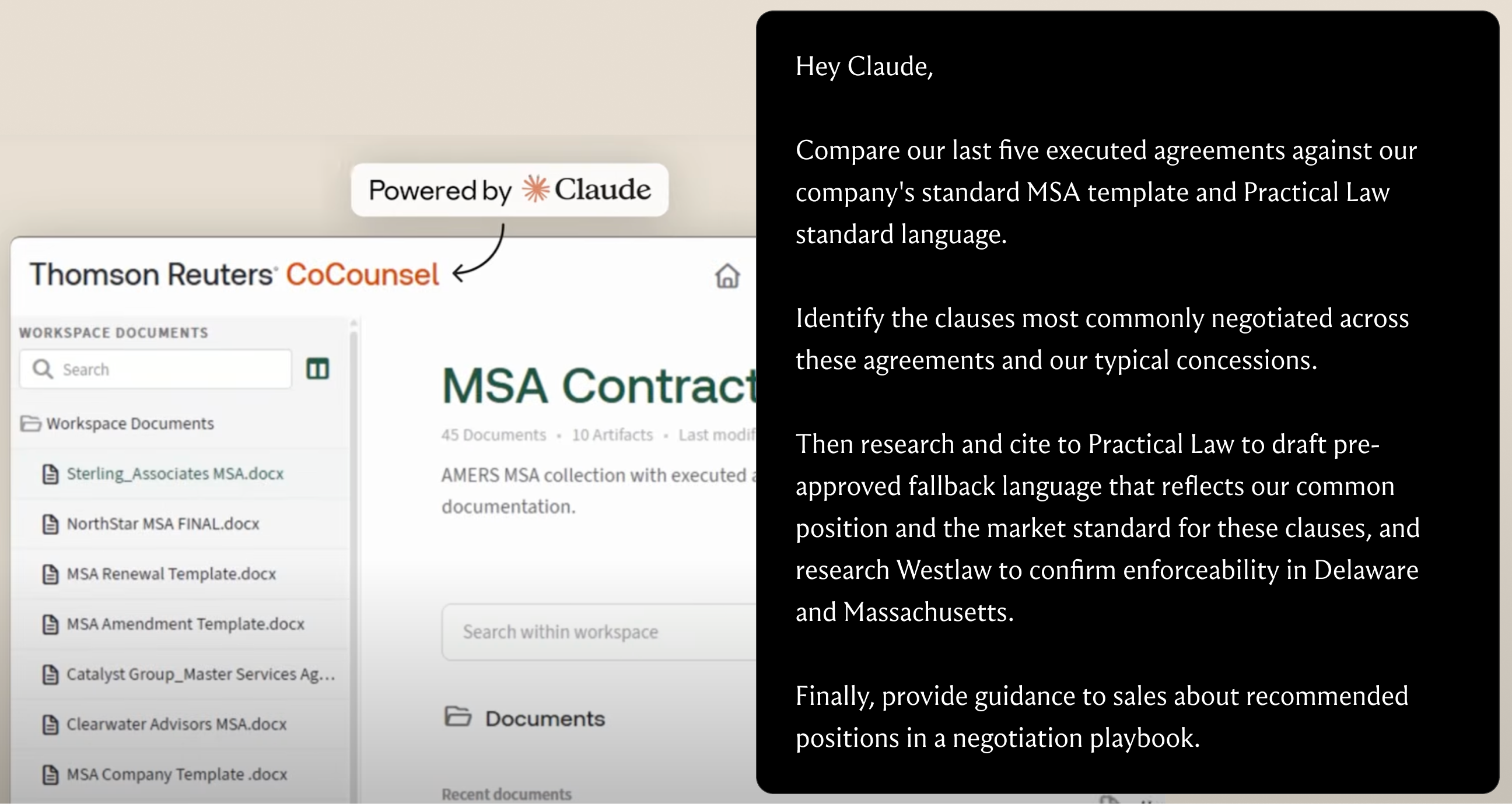
This is CoCounsel (Thomson Reuters) powered by Claude. The prompt:
Compare our last five executed agreements against our company's standard MSA template and Practical Law standard language. Identify the clauses most commonly negotiated across these agreements and our typical concessions. Then research and cite to Practical Law to draft pre-approved fallback language that reflects our common position and the market standard for these clauses, and research Westlaw to confirm enforceability in Delaware and Massachusetts. Finally, provide guidance to sales about recommended positions in a negotiation playbook.
That's a multi-step workflow that would have taken a junior associate days. Now it's a single prompt to an agent with access to:
- Your document management system (the executed MSAs on the left)
- Your company's standard templates
- Legal research databases (Westlaw, Practical Law)
- The ability to synthesize across all of these
The lawyer's job becomes: knowing what questions to ask, validating the output, bringing judgment the model can't replicate.
The Insight
What's happening here is the knock-on effect of mounting an AI agent on your case and document management system.
That's the mental model. Not "using an AI tool" like a calculator. Directing an agent that has access to your entire legal infrastructure: every document you've touched, every database you subscribe to, every precedent your organization has created.
The value proposition shifts. You're not selling research hours. You're selling the judgment to know what to ask, whether the answer is right, and what to do with it.
The lawyers who get this will charge for outcomes, not inputs. The lawyers who don't will wonder why the phone stopped ringing.